More efficiency, less waste – a practical introduction
In many companies, Lean Six Sigma is understood as a uniform concept – or even more frequently: as a synonym for process optimisation. This is precisely where one of the biggest misunderstandings begins.
Reducing waste is often equated with stable processes and consistently good quality. But these are not the same thing.
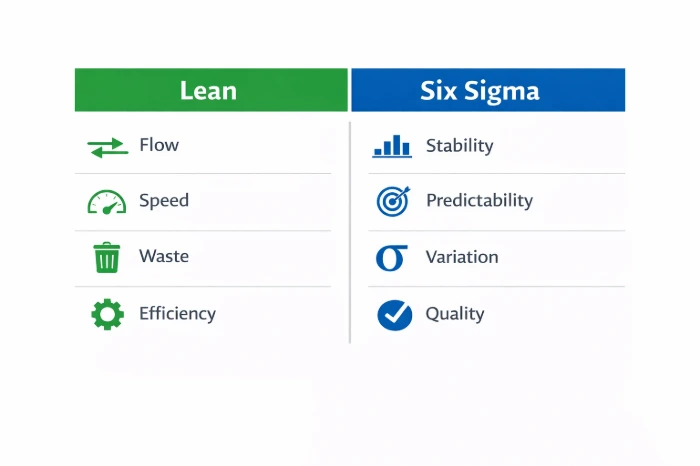
- Lean improves the flow of a process by removing unnecessary steps, waiting times and complexity.
- Six Sigma ensures that a process functions reliably and reproducibly delivers the same quality.
A process can be very lean – and yet unstable. A process can be very stable – and yet slow and expensive.
This is precisely why both approaches were combined. Lean without Six Sigma often leads to faster but still error-prone processes. Six Sigma without Lean stabilises processes that may remain unnecessarily complicated.
Lean Six Sigma therefore does not simply mean ‘optimising’, but rather systematically solving two different types of problems:
- Efficiency problems (time, effort, costs) → Lean
- Quality and stability issues (variation, errors, predictability) → Six Sigma
Only the interplay of both perspectives enables sustainable improvement.
What is Lean Six Sigma?
Lean Six Sigma combines two proven management approaches:
Lean management
Lean focuses on eliminating waste (Japanese: muda). Every activity in a process is scrutinised: does it really contribute to customer benefit?
Typical forms of waste include, for example:
- unnecessary waiting times
- overproduction
- duplicate data entries
- unnecessary transport routes
- correction loops
- excessive stock levels
- unnecessarily complex approval processes
Lean makes processes faster, more transparent and simpler.
Six Sigma
Six Sigma focuses on the quality and stability of processes. It is not only speed that is important, but above all predictability. A good process does not deliver good results occasionally, but consistently.
To this end, data is used to systematically identify and eliminate the causes of errors. Decisions are based on facts rather than gut feeling.
The combination
Lean makes processes efficient. Six Sigma makes processes stable.
Together, they form a powerful approach to structured process improvement: Lean Six Sigma.
The core: The DMAIC cycle
Most improvement projects follow a clear structure – the so-called DMAIC cycle.
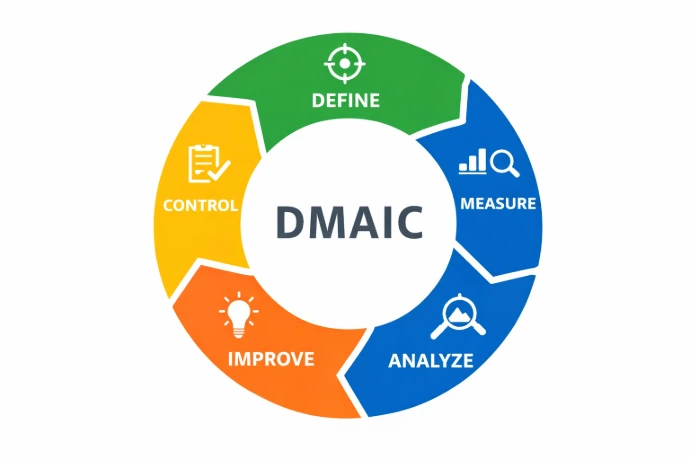
1. Define
First, the problem is described precisely:
- What exactly is not working?
- Who is affected?
- What are the consequences (costs, time, quality, customer satisfaction)?
Important: Many organisations start too quickly with solutions here. Lean Six Sigma deliberately begins with understanding the problem.
2. Measure
Data is now being collected. The aim is to obtain an objective picture of the current situation:
- lead times
- error rates
- rework
- process variations
It is often only when measurements are taken that assumptions are found not to correspond to reality.
3. Analyse
In this phase, the actual cause is sought – not the symptom. Typical questions:
- Why do errors really occur?
- Where in the process do deviations begin?
- What factors influence the result?
It often turns out that the problem rarely lies with individual employees, but almost always with the process design.
4. Improve
Targeted solutions are now being developed and tested. Examples:
- clear handover rules
- Standardisation of work steps
- Reduction of interfaces
- visual control
- Automation of individual steps
Important: Improvements are piloted, not rolled out immediately across the board.
5. Control (Securing)
To ensure that improvements have a lasting effect, they are safeguarded:
- standards
- key figures
- responsibilities
- training courses
It is this phase that prevents organisations from falling back into old patterns after a few months.
What Lean Six Sigma is not
A common reason for scepticism: false expectations.
Lean Six Sigma does not mean:
- job cuts
- permanent monitoring of employees
- more bureaucracy
- Complex statistical programmes for everyday use
On the contrary: when applied correctly, Lean Six Sigma reduces stress because processes function more clearly and fewer firefighting operations are necessary.
Typical results from practice
After successfully implementing projects, organisations often report:
- 20–50% shorter turnaround times
- significantly fewer errors and complaints
- less internal coordination
- clearer responsibilities
- higher employee satisfaction
- improved adherence to deadlines
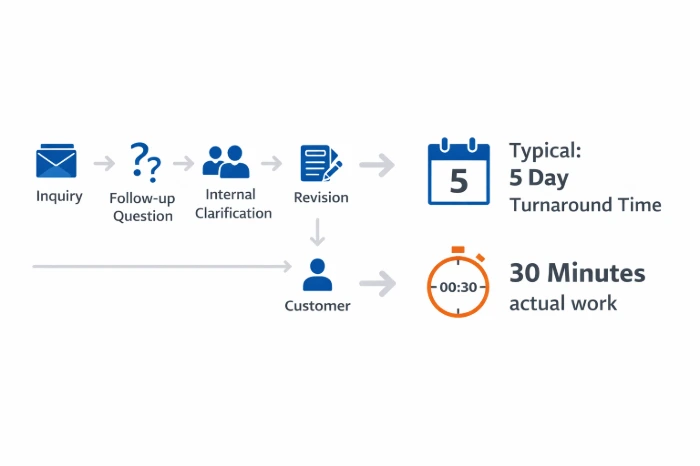
However, the most important effect is usually a different one: transparency. Problems become visible – and thus solvable.
Where Lean Six Sigma can be used
Lean Six Sigma is no longer purely a production issue. It works wherever processes exist:
- Administration and back office
- shopping
- logistics
- project management
- IT-Service
- healthcare
- service company
The potential is often particularly great in administrative areas, because processes have developed over time and have rarely been designed systematically.
First steps for your business
If you want to introduce Lean Six Sigma, start small:
- Select a specific problem (e.g. long quotation turnaround time). See our package initial consultation and process-quick check
- Make the process visible (process mapping with the employees involved). See our package process recording
- Measure the current situation – even simple figures are sufficient at the beginning. See our package data analyses und market analyses
- Identify the root cause, not the loudest guess. See our package root cause analysis
- Try out a small improvement within a few weeks. See our package process design and transformation roadmap 360°
- Check whether the improvement works. See our package gemba walks and process performance.
The biggest mistake is trying to transform the entire company at once. Lean Six Sigma starts successfully with a single, well-chosen project.
Conclusion
Lean Six Sigma is not a short-term optimisation initiative, but rather a mindset: problems are not covered up, but understood. Decisions are based on facts rather than assumptions. Processes are designed in such a way that good results do not depend on chance.
Companies that consistently pursue this approach gain more than just efficiency: they gain stability, predictability and trust – among both customers and employees.
Would you like to know whether Lean Six Sigma is right for your company? Then start by analysing one of your core processes with our packages initial consultation and process-quick check": Where do delays, queries or errors occur? That is precisely where improvement begins.
If you would like to receive more information, valuable advice and the latest news, visit our blog regularly and subscribe to our Newsletter.